Wood & Sidara
So last time, I was thinking about how important it would have been to read up on financials. Not that it should necessarily affect what you decide to do as an employee, but as an employee-investor, maybe it should. I write this article not to lambast or criticize Wood; indeed, I really cannot emphasize enough the great times I’ve had with some of my colleagues and the culture we had. But gross mismanagement, even at levels that I was not never privy to nor had any reason to concern myself with, is the root cause of the woes Wood faces.
Two major things have happened since then. First the bad news and then the maybe good news.
The Review
On March 31st, Wood announced that the Deloitte review found material weaknesses. There’s a lot of stuff to sift through in the announcement, but the critical aspect is the fact that this entire division of the company was playing fast and loose with finances. While the word “fraud” is not used, to me, this is what fraud is. Merriam-Webster 1b:
an act of deceiving or misrepresenting
Cornell Law also has something to say:
In civil litigation , allegations of fraud might be based on a misrepresentation of fact that was either intentional or negligent . For a statement to be an intentional misrepresentation, the person who made it must either have known the statement was false or been reckless as to its truth. The speaker must have also intended that the person to whom the statement was made would rely on it. The hearer must then have reasonably relied on the promise and also been harmed because of that reliance .
Perhaps this should have been obvious to a layperson as the only possible explanation, but I think to a lot of my colleagues, it was surprising. Why jeopardize your ethical standard and responsibility to your colleagues, your industry, your company, your country, and most importantly, to yourself? And for what? A short term pat-on-the-back?
Key paragraph from the statement:
As a result of the Review, Wood has identified material weaknesses and failures in the Group’s financial culture within the Projects business unit and engagement between Group Finance and Projects. This included inappropriate management pressure and override to maintain previously reported positions, including through unsupported dispensations, and over-optimism and/or lack of evidence in respect of accounting judgements. The cultural failings appear to have led to instances of information being inappropriately withheld from, and unreliable information being provided to, Wood’s auditors.
Something has triggered Wood to need to reissue historical fiscal year reports as well as delay issuing FY24. That might not be so crazy, but because the delay in releasing results after after April 30th, shares have to cease trading on the LSE. What is even more surprising, however, is the fact that Wood had to secure waivers from its debt holders for possible violations of the financial covenants of its loans. Again, for those acquainted with commercial debt, this may be obvious, but I did not realize the extra stipulations commercial entities had to deal with as it came to loans and what the consequences can be i.e. accelerated repayment.
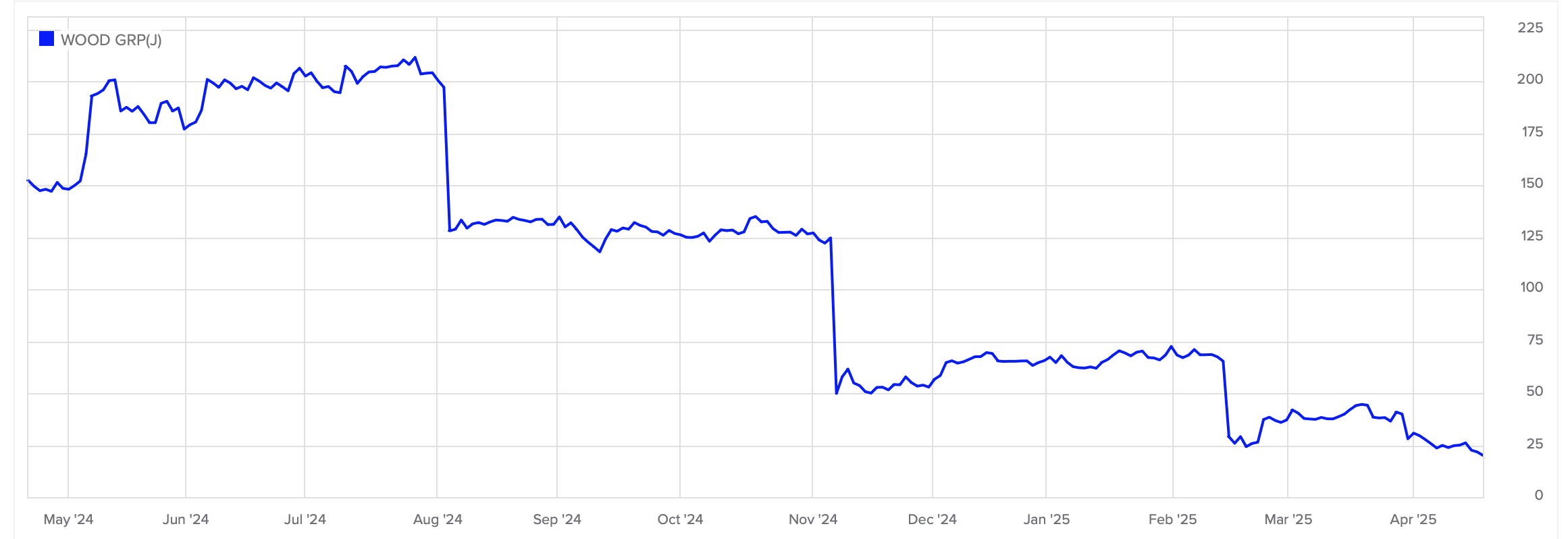
Share price was not happy. When the value of your whole company dips below what a very conservative EBIT-multiplier value would say, it means the market is totally done with you. So, what happens next is equally unsurprising when viewed from this lens.
The Possible Offer
On April 14th, Wood and Sidara announced that there is now a non-binding possible offer. It laid out preconditions, details, how Sidara will offer liquidity, etc., but as expected, no actual commitment. Just a whole bunch of “possible”, “intend”, and “no certainty”. The details I think are the interesting bit. Effectively, Sidara is offering to acquire Wood at £0.35 per share. As of this writing, there are 691839369 outstanding shares meaning the value in this proposal is £242.1M or approximately $319.6M. In addition, it will do a “capital injection” of $450M to restructure the business’s debts or finances. However, I think this is somewhat misleading. While in employee focused communication, the CEO has focused on this big number as way of indicating that this is a good thing, the official language used is that this is a loan given under the same terms as existing debt. With that said, they could be choosing not to reveal that it’d be forgiven if the Offer were to complete or that it would be at substantially lower interest rates in the future, but to me, this makes me feel bad. Why purchase a company and affect roughly thirty thousand people and their careers when there are no tangible assets and you’re just providing more debt facilities to the beleaguered firm? I simply don’t understand.
All in all, the market doesn’t believe the offer is going to go through for one reason or another. As of today, trading is at 20p with the offer at 35p.
The one part that gives me hope is this from the announcement:
Sidara fully recognises the value of Wood’s talent and if an Offer is made which completes, Sidara intends to support Wood in taking actions to retain and support employees to ensure business continuity. This includes a commitment to uphold Wood’s pension obligations, ensuring schemes are funded in line with governing documents and statutory requirements.
That gives me some hope, but against the backdrop of massive destruction of value, an austerity mindset, and a changing industry/market/world, it’s hard to focus on the positive. An acquisition by Sidara, in my opinion, would be good for employees and clients without a doubt. But the fact that Sidara attaches so much uncertainty to every announcement (e.g. difficult or even impossible pre-conditions to a formal offer which may not even be accepted by shareholders), it does make me question whether that uncertainty extends to how it acts in private.
Other tidbits I am not focusing on:
- As said in the possible offer, if this doesn’t go through, Wood will need to raise equity or do more disposals. Raising equity as a public company means diluting shares, and for whatever reason, that just seems bad. Disposals are fine, but if you’re cutting off an arm to conserve blood that you are losing through your leg, are you accomplishing anything in the end?
- In mid 2024, when Wood was entertaining offers for £2, Wood made statements like “The Board carefully considered the Proposal, together with its financial advisers, and concluded that it fundamentally undervalued Wood and its future prospects” like here.
- The role of the CEO/CFO in getting to this point. I will not belabor the point, but if you were offered to take the helm of a struggling company, would you not invest your attention into the parts that are struggling?
- Insolvency and the resulting bankruptcy if a waiver extension is not secured in a timely way.
- How a Ch. 11 bankruptcy could be better than this sale
- Morale of the staff with all of these events ongoing.
More to come, I am sure.